 QLB
QLBMost tokens launch by screaming. Faster, higher, sooner, moon. QLB is the opposite bet: a coin whose entire personality is patience — and a case study in taking a joke seriously enough to design it properly, mint it onchain, and give it a home.
Why mint a coin at all?
I wanted to run the complete onchain creative loop myself — not read about it. Naming, a visual identity, the on-chain mechanics, the metadata, the wallet experience, the launch surface. The point wasn't speculation; it was to stand inside the medium a creative director for an onchain brand actually works in, and to come out the other side with opinions earned rather than borrowed.
QLB became that vehicle. A real SPL token on Solana, designed as if it mattered — because the craft is the same whether the joke is worth $0 or $0 with a following.
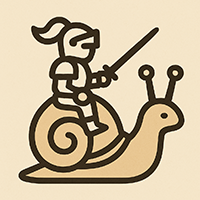
A knight riding a snail.
The whole identity fell out of a single image. A knight in full armor, lance raised, charging valiantly into battle — on the back of a snail. It's funny for one second and then it isn't, because it's also just… true. Conviction without speed. Showing up in armor for a fight that will take a very long time.
Slow is smooth. Smooth is unstoppable.
That line became the voice. In a feed full of rocket emojis, a token that openly promises to be slow is the pattern interrupt. The mark isn't decoration for the idea — the mark is the idea, and everything downstream just had to stay loyal to it.
Warm, not neon.
Crypto's default palette is black glass and electric gradients. QLB goes the other direction entirely: parchment, ink, and a medieval gold — an illuminated-manuscript feel that makes the knight look like he belongs on a coin struck a few centuries ago. The restraint is the signal. It reads as considered in a category that mostly reads as loud.
Parchment ground, gold accent, ember for the snail's shell, ink for type.
A token page built on honesty.
The launch site's organizing principle is that every claim is verifiable. The supply, the decimals, the mint authority — each one links straight to the block explorer, one tap to copy the mint, one flow to add it to a wallet. No unfalsifiable promises; the page is a window onto the chain, not a pitch deck.
- Copy-to-clipboard mint address and authority, both linked on-chain.
- Step-by-step “add QLB to your wallet” for Phantom and Solflare.
- Tokenomics shown as an illustrative, clearly-labelled plan — not a fake promise.
- A disclaimer that says the quiet part out loud: it's on devnet, it has no monetary value, do your own research.
Designing the honesty in was a choice. The fastest way to lose an onchain audience is to be caught overstating; the most durable way to earn one is to be the project that never made you squint at the fine print.
When the logo wouldn't load, I read the chain.
After minting, the icon refused to appear in wallets. This is where a token identity usually dies in a handoff — designer ships a PNG, engineer wires it up, nobody owns the seam. Here there was no seam. A wallet resolves a token image through a chain of pointers, and I traced it:
# wallets resolve an icon through three hops:
on-chain uri  →  off-chain JSON  →  its "image" field  →  the PNG

# what I found:
uri pointed at a JSON whose "image" was a hotlinked Wix AVIF URL
  └─ wallets choke on it  → no icon

# the fix:
1. write a correct off-chain JSON  (image → the PNG pinned on IPFS)
2. metaboss update uri  --account <MINT>  --new-uri <gateway/CID>
   # not "create metadata" — 0xc7 means the account already exists
3. metaboss decode mint --account <MINT>   # verify
It's a small bug. It's also the entire pitch: a creative director who can follow the idea all the way down into the metadata, the CLI, and the IPFS pin — and back up into the wallet the user actually sees — doesn't need a translator between the concept and the chain.
Shipped, and deliberately on devnet.
QLB is live and real: minted, branded, and fronted by a production site at qlb-web.vercel.app. It sits on devnet on purpose — a full-dress rehearsal of the launch motion before any real value or liquidity is involved. The mainnet plan (fresh mint, carried-over identity, seeded liquidity, listings) is mapped on the site's own roadmap.
What I'd bring to an onchain brand.
- One hand from idea to artifact. Concept, identity, copy, the site, and the on-chain mechanics — no relay race, no lost meaning between design and deploy.
- The chain as a medium, not a checkbox. Verifiability and honesty designed in, because that's what an onchain audience actually rewards.
- Reactive and fast. This went from a one-line joke to a live, minted, documented project — the same motion a real-time creative role runs on.